What is the best book for big data analytics?
People with big data and data science skills are some of the most sought after professionals because demand is outstripping supply. Here are 10 books that can help you learn everything about the emerging field and the tools you will need to conquer it.
Best Big Data Books To Boost Your Career
The Best Big Data & Data Analytics Books Of All Time
1) Data Analytics Made Accessible, by A. Maheshwari
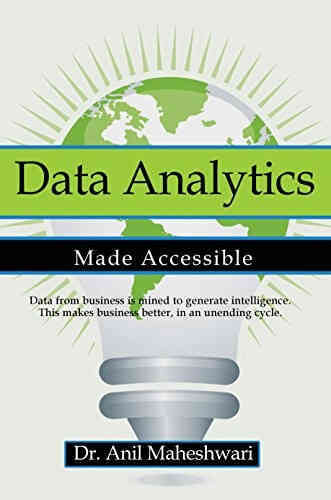
Best for: the new intern who has no idea what data science even means
Example of a rave review:
“I would definitely recommend this
book to everyone interested in learning about Data Analytics from
scratch and would say it is the best resource available among all other
Data Analytics books.” —reader’s review
If we had to pick one book for an
absolute newbie to the field of Data Science to read, it would be this
one. Updated for 2017, “Data Analytics Made Accessible” is one of the
best books on data analytics, and does exactly what its name implies: it
exaplains data analytics in an easy way, and makes them understandable
and digestible for the uninitiated.
The book promotes easy understanding through:
- Concrete, real world examples at the beginning of each chapter
- An intuitively organized layout structured like a one semester college course
- Case studies throughout each chapter to tie the material together
Due to its scope of content and clear
explanation, “Data Analytics Made Accessible” has been made a college
textbook for many universities in the US and worldwide. The author, Anil
Maheshwari, Ph.D., has both practical and intellectual knowledge of
data analytics, as he worked in data science at IBM for 9 years before
becoming a professor.
The book also has some “crowdsourced”
material, as the 2017 edition had 4 chapters added based on feedback
from reviewers and readers. At 156 pages on Kindle, this is a book you
could finish in one (long) sitting if you were so inclined, that you can
also use as an inspiration when you work with your business intelligence software.
2) Predictive Analytics: The Power to Predict Who Will Click, Buy, Lie, or Die by E. Siegel

At less than $15, this book and its Kindle version hold the #1 and #2 Best Seller positions in both "Business Planning & Forecasting" and "Econometrics" on Amazon.com.
3) Data Smart: Using Data Science to Transform Information into Insight, by J. W. Foreman
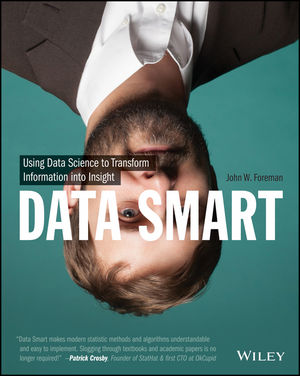
But how does one exactly do data science? Do you have to hire one of these priests of the dark arts, the "data scientist," to extract this gold from your data? Nope.
Data science is little more than using straight-forward steps to process raw data into actionable insight. And in Data Smart, author and data scientist John Foreman will show you how that's done within the familiar environment of a spreadsheet.
Why a spreadsheet? It's comfortable! You get to look at the data every step of the way, building confidence as you learn the tricks of the trade. Plus, spreadsheets are a vendor-neutral place to learn data science without the hype.
But don't let the Excel sheets fool you. This is a book for those serious about learning the analytic techniques, the math and the magic, behind big data.
Each chapter will cover a different technique in a spreadsheet so you can follow along:
- Mathematical optimization, including non-linear programming and genetic algorithms
- Clustering via k-means, spherical k-means, and graph modularity
- Data mining in graphs, such as outlier detection
- Supervised AI through logistic regression, ensemble models, and bag-of-words models
- Forecasting, seasonal adjustments, and prediction intervals through monte carlo simulation
- Moving from spreadsheets into the R programming language
Commentaires
Enregistrer un commentaire